Braille Printing in Australia
Accessible communication is no longer optional. For businesses, government agencies, and not-for-profits that communicate with the public, providing information in Braille is both a legal requirement and a mark of genuine inclusion.
Yet many organisations are unsure where to start. What standards apply? Which documents need to be in Braille? What does the process actually involve? This guide covers everything you need to know about Braille printing in Australia, from the basics through to how to commission your first Braille document.
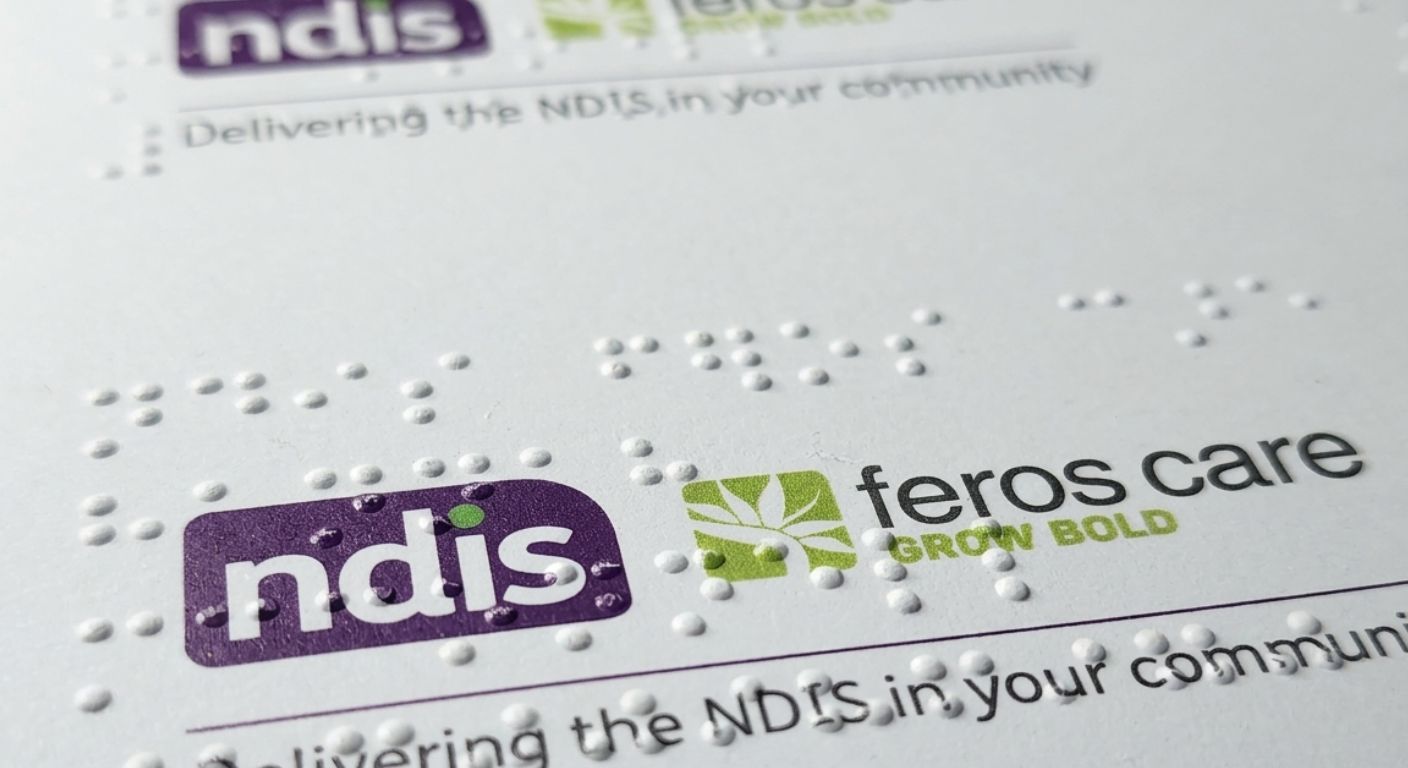
What is Braille printing?
Braille is a tactile writing system used by people who are blind or vision-impaired. Rather than visual characters, Braille uses a series of raised dots arranged in cells, each representing a letter, number, or punctuation mark. Readers run their fingertips across the page to feel and interpret the text.
Braille printing, more precisely called Braille embossing, involves pressing raised dots into paper or card using a specialist piece of equipment called a Braille embosser. Unlike standard printing, the process deforms the paper to create the raised dot pattern rather than applying ink to the surface.
In Australia, Braille is used in two main grades:
- Grade 1 Braille uses a direct letter-by-letter transcription of standard text. It is easier to learn and read for those new to Braille.
- Grade 2 Braille uses a contracted system with abbreviations and shorthand for common words and letter combinations. It reads faster and fits more content per page, making it the preferred format for longer documents.
Flagstaff’s Braille transcription and printing service covers both grades, across document sizes from business card through to A3, printed single or double-sided. What makes our braille service unique is we can print words as well as Braille on the same page.
Who needs Braille documents in Australia?
Around 575,000 Australians live with blindness or vision impairment, according to Vision Australia. For many of these individuals, Braille remains the primary way to access written inormation independently.
Organisations with a legal or ethical obligation to provide accessible communications include:
- Government agencies at the federal, state and local levels, particularly those communicating with the general public about services, rights and entitlements
- Healthcare providers and hospitals provide patient information, consent forms, appointment details and medical instructions
- Financial services organisations distributing statements, product disclosure documents and terms and conditions
- Hospitality, tourism, and retail businesses want to make their menus, signage and promotional materials accessible
- Not-for-profits and disability services organisations communicating with clients and communities who may rely on Braille
- Corporates with Diversity, Equity and Inclusion commitments, looking to make their communications genuinely inclusive
If your organisation produces printed communications that are distributed to the public, there is a strong case for considering whether a Braille version should be available on request or included by default.
Australian accessibility standards for Braille
In Australia, the primary legislative framework for accessibility is the Disability Discrimination Act 1992 (DDA). The DDA makes it unlawful to discriminate against a person on the grounds of disability, including in access to information and services. Failing to provide information in an accessible format, including Braille, can in some circumstances constitute discrimination under the Act.
Complementing the DDA, the Australian Human Rights Commission provides guidance on accessible communication practices. Government agencies are also bound by the Web Content Accessibility Guidelines (WCAG) for digital content and increasingly by broader accessibility expectations for physical communications.
For Braille specifically, the relevant standards include:
- Unified English Braille (UEB) is the standard Braille code adopted in Australia, New Zealand and across the English-speaking world. UEB replaced the previous Australian Braille Authority code and is the format used for all English-language Braille production in Australia.
- Australian Standard AS 1428 covers design for access and mobility, including tactile ground surface indicators. For signage in public spaces, AS 1428.1 sets out requirements for tactile and Braille signage in buildings.
If you are unsure which standard applies to your organisation or document type, our team can advise based on your specific context.
What types of documents can be printed in Braille?
Most printed documents can be produced in Braille, provided the content is supplied in a format that can be transcribed. At Flagstaff, we regularly produce Braille versions of:
- Business cards
- Brochures and information leaflets
- Menus and hospitality materials
- Flyers and event programs
- Annual reports and corporate publications
- Manuals and training materials
- Government correspondence and public information documents
- Posters and signage inserts
Documents can be produced in Braille alone, or with standard print and Braille side by side on the same page, allowing sighted and vision-impaired readers to share the same document. Our team will advise on the best approach depending on your content, format and audience.
How does the Braille printing process work?
Getting a document produced in Braille is more straightforward than many organisations expect. Here is how the process typically works when you work with Flagstaff.
1. Supply your content
You provide your document in a standard format, such as a Word file, PDF, or text document. If your source file contains images or graphical elements, our team will advise on how to handle them, as images cannot be transcribed directly into Braille but may be described in text.
2. Transcription
Our team transcribes your content into the correct Braille grade, either Grade 1 or Grade 2, depending on your requirements and audience. Transcription requires specialist knowledge to ensure the correct Braille codes, contractions and formatting conventions are applied. This process cannot be automated reliably, which is why working with an experienced Braille printing provider is important.
3. Proofing
Before production, we provide a proof for your approval. For Braille documents, this typically involves a print-ready file showing the embossing layout, along with a back-translation of the Braille content into standard text to verify accuracy.
4. Embossing and finishing
Once approved, your document is produced using our specialist Braille embossing equipment. We print on heavyweight paper or card to ensure the raised dots hold their shape and are easy to read. Documents can be finished with binding, folding, or inserted into envelopes for distribution through our mail service if required.
5. Delivery or mailing
Completed Braille documents can be collected from our Wollongong facility, delivered directly, or distributed through our bulk mail service. If you need Braille documents mailed to individual recipients, we can manage the entire process from print to post box.
How much does Braille printing cost in Australia?
Braille printing is more costly than standard printing because of the specialist equipment, transcription expertise and heavier paper stock required. Pricing varies depending on:
- The length and complexity of the document
- Whether you require Grade 1 or Grade 2 transcription
- Single or double-sided embossing
- Document size (business card through to A3)
- Quantity required
- Finishing requirements, such as binding or envelope insertion
The best way to get an accurate cost is to contact our team with the details of your project. We provide customised quotes based on your specific requirements and we are happy to help you think through the most cost-effective approach for your needs.
Why choose Flagstaff for your Braille printing?
Flagstaff Print, Mail and Digital has been providing Braille transcription and printing services to government, corporate and not-for-profit clients across Australia. We offer Grade 1 and Grade 2 Braille across a full range of document sizes, with expert transcription and quality assurance built into every job.
Our clients include organisations like Hireup, who specifically chose Flagstaff for our ability to produce Braille business cards as part of their commitment to accessibility. We understand what it means to produce communications that work for everyone.
But there is another reason to choose Flagstaff. We operate as a social enterprise under The Flagstaff Group, providing inclusive employment for people with disability. When you commission Braille printing from Flagstaff, you are not only making your own communications more accessible, you are supporting a business that is built on the principle of inclusion.
If your organisation has social procurement commitments, your Flagstaff spend counts toward your targets as a verified social enterprise.
Ready to make your communications more accessible? Contact our team today or call us on 02 4272 0257 to discuss your Braille printing requirements.
Frequently asked questions
What is the difference between Grade 1 and Grade 2 Braille?
Grade 1 Braille is a direct letter-by-letter transcription of standard text, suitable for readers who are new to Braille or for shorter documents such as business cards and labels. Grade 2 Braille uses a contracted system with abbreviations for common words and letter patterns, which makes reading faster and reduces the number of pages required for longer documents. Most experienced Braille readers prefer Grade 2 for extended reading.
What Australian standard applies to Braille?
The relevant Braille standard for Australia is Unified English Braille (UEB), which replaced the previous Australian Braille Authority code. For signage in public buildings, Australian Standard AS 1428.1 covers requirements for tactile and Braille elements. The Disability Discrimination Act 1992 provides the broader legal framework for accessible communication in Australia.
How long does Braille transcription and printing take?
Turnaround time depends on the document's length and complexity and the quantity required. Simple documents such as business cards or short brochures can typically be completed within a few business days once the content is approved. Longer documents or large print runs require more time. Contact our team with your project details and we will provide an accurate timeframe.
Can I have standard print and Braille on the same page?
Yes. It is possible to produce documents with both standard printed text and Braille on the same page, which allows sighted and vision-impaired readers to share the same document. This approach works particularly well for business cards, menus and short information pieces. Our team will advise on layout and paper weight to ensure both the print and the Braille are clear and readable.
What documents can Flagstaff produce in Braille?
Flagstaff can produce a wide range of documents in Braille, including business cards, brochures, menus, flyers, annual reports, manuals, government correspondence and event programs. If you have a specific document in mind, contact us and we will confirm whether it can be produced in Braille and advise on the best approach.
Does choosing Flagstaff help meet social procurement requirements?
Yes. Flagstaff Print, Mail & Digital is a verified social enterprise, meaning government agencies and organisations with social procurement commitments can count their spend with Flagstaff toward their procurement targets. Every Braille job you commission with us also supports meaningful employment for people with disability.